Showing posts with label media. Show all posts

10 December 2012

Fixing the news

It's been a little while since the Finkelstein report came out, and we've since seen the Leveson report come out in the UK.  We've also seen the response to Leveson by the British Prime Minister, David Cameron.

The same thing is pretty much happening here with Finkelstein.  Thanks to articles like this, the hysterical reaction pretty much ensures that any government that wants to enforce standards on the news media will be considered to be recklessly trampling free speech beneath satanic jackboots in an Orwellian orgy of dictatorial facsism by the time that media is finished with them.

I don't support this at all.  Leaving aside regulation for a moment, no one seems to have twigged that the problem is with news itself.  In short, we don't really get it any more.  We get something that looks like news, but is quite slanted and biased and, as I alluded to in my previous posts, we now are getting some pretty second-rate product that we, as consumers, don't really deserve.

In other words, the market is not providing and therefore, there is market failure.  Which, in other industries, means that it's time to regulate.

So, I thought I'd have a good think about this.  What is is that we would like a news service to provide us with?  What is it that we, as consumers, think of when we think of news?

31 August 2011

Credit where credit's due

Andrew Bolt (Hun/Tele/Advertiser) had a blog post pulled on Monday.  Mainly due to the fact that his post could have been interpreted as muckraking by making a big song and dance about a fraudulent Glenn Milne article in The Oz.  An interesting part is that some are suggesting that Bolt might have posted after Milne’s column was pulled.  Not only that, but News left the post online for a considerable amount of time after Milne's article was removed.

Milne, of course, is best known for attempting to blue Stephen Mayne one year on stage at the Walkley Awards.  I had absolutely no need to mention that, but I'm hedging my bets in case Bolt is correct about his post being 'fair, accurate and in the public interest'.

Today, in his column, he’s got me in stitches by squealing “censorship”.  The problem with Bolt’s brand of satire, is that it’s often lost on his audience, who see his character’s flagrant racism and bullying as being the real deal.  And this is where the problem starts.

I’m aware that Bolt’s blog is a bit of a testing ground for his wilder humour.  What goes out there gets tested amongst the comments from the fruitcakes that dominate his readership and the eventually worked on a little harder.  Eventually, Bolt creams off the stuff that’s silly enough to outrage and amuse, yet the stuff that’s too ‘out there’ gets forgotten about.  What’s left gets written up as ‘proper’ copy in his columns in News’ south eastern newspapers.

28 July 2011

On why the media should embrace more regulation. Part 2

 In our first part, we heavily criticised News Corp for just being a bad news organisation.  By that, I mean that as a news organisation, they are bad.  Incredibly bad.  (I didn’t mean that they just produce bad news, oh heavens to Betsy, no)

It should be pointed out, though, once again, that I was only singling out News as the worst of what appears to be a very bad bunch.  I listed a whole bunch of crimes committed by the media in part 1, some of which were also committed by other media sources as well.

A really good example of disgraceful media practice that is committed across the board, is the tendency of the financial media to regurgitate media releases from companies, without any sort of objective research.  Media Watch appears to have strangely left financial journalists alone to date, but will pursue other journalists who regurgitate press releases.

22 July 2011

On why the media should embrace more regulation. Part 1

Over the last few weeks we’ve seen some rather interesting stuff in the media involving the media. We’ve seen all hell break loose in the UK with what appears to be becoming known as ‘Hackgate’. We’ve seen the Herald-Sun publish a call to assassinate the Prime Minister. We’ve also seen the media circuses around the cases of Dominique Strauss-Khan and Casey Anthony where the media essentially judged these folks guilty before their cases had even been heard. In Anthony’s case, they then screamed hysterically about the jury being wrong, even publishing questionable articles where jurors allegedly disclosed a preference for going home rather than finding someone guilty.

I think I'll avoid the issue about concentrated media ownership – it’s probably outside the realm of what I want to blog about here, but what I will add is the sheer, unmitigated bias that passes for journalism in anything that comes out of News Corporation.  Although, it's fair to say that 2UE are probably much worse.

06 April 2009

Cracking the sads with the media, episode 426: The GFC and superannuation


Those who read this blog will know all about my thoughts on the media. Some of you will also be probably saying, “There’s been a GFC. Why have you been so silent?”

I admit to being busy with other stuff in meatspace, and I haven’t blogged in a little while, so shame on me. But finally, I’m going nuts again, and you can all shut up and read for all I care because there’s stuff that simply has to be said.

The media has been all over superannuation funds for quite some time. True, this is the biggest exposure Australians will ever have to volatile investment markets outside their own home. And yes, for those of you who like to read between the lines (you know who you are) there was a subtle dig buried in that sentence.

Part of the negative press aimed at super funds is simply unwarranted, and here’s the reason why: Chances are big that you need to shoulder what could potentially be the lion’s share of responsibility for that diminishing nest egg.

That’s right folks. You, or at least most of you who are reading, are almost fully culpable. Not your super fund. Possibly your financial adviser, if you have one, but this ain’t aimed at you if you have. That will be the subject of a different post, so if you have a financial adviser, you can consider yourself in the clear. At the moment.

For those of you who don’t use a financial adviser, I suspect that you are having a grand old time criticising your super fund for what is, for most of you, a year and a half of negative returns. Let’s face it; we love to have a go at stuff that shits us. As a nation, we love to stick it up the poms when they’re complaining, but to be frank; we’re a nation of whingers. Possibly even worse than the English.

We’re also a nation that hates to accept personal responsibility.

Put these two traits together, and you’re left with the kind of sensationalist reporting that sees the media (News in particular, but Fairfax is a close second) putting out tripe like this or this and Australians lapping it up like the sheep that that they are.

I’ve said it before and I’ll say it again: Australians are shithouse investors and it’s time that you were all told. As an investor, the chances are that if you’re reading this, you suck.

Permit me to now explain why you potentially suck.

Superannuation is not a type of investment. It’s a tax environment.


John Smith (not his real name) is 58 and recently retired. Naturally, he’s rather upset at his super fund’s return of -20% over the past year. And he’s only in the fund’s ‘balanced’ option.

He spots an ad for an online account in the newspaper paying 4.50% and thinks to himself, “At least this is positive.”

John empties his super fund and sticks the entire amount, lock, stock and barrel into this online account. John is, quite frankly, a goose.

On John’s current marginal rate of tax (30%), the rate of interest becomes less attractive at 3.15%, not including Medicare.

On top of this, John simply doesn’t want to know that he could have invested in a cash option in his super fund which is only taxed at a concessional rate of 15%. He’s that pissed off. In fact, the bank that offers this account also offers an identical account to self-managed super funds, thus yielding a superior return after tax of 3.825%.

And because John is not 60 yet, he’s going to be in for a fright at tax time when he finds himself hit with a tax bill in the tens of thousands of dollars on his lump sum super withdrawal.

Can it get any worse?

You bet. John also couldn’t care less that, had he switched to the pension phase of super, his assets aren’t even subject to tax on their earnings. Holding this online account within a self-managed super fund in the online phase would have yielded the full 4.50%.

Not only that, because John has withdrawn the amount from super he is going to have serious problems if he ever wants to start up a super pension, because he won’t be able to get the whole thing back into super if he tries. Amounts able to be contributed to super in a financial year are subject to contribution caps, which limits his flexibility in this regard.

John might be a retiree, but I have no sympathy for him.

Notice that I haven’t talked about John’s potential exit fees, John’s lost insurance coverage or the likelihood that he’ll miss a market upswing. Well I wasn’t going to, anyway.

You choose your investments (part 1)


Jo Phelps (not her real name) is 40 and a manager with an HR recruitment firm.

About a year and a half ago, she received her annual super statement from her fund. Jo was in the balanced option of her fund which had been performing quite respectably for the past four years posting regular returns of 15%.

Her balanced option is about 70% shares and property and 30% cash and fixed interest.

But when she saw the returns on the fund’s ‘high-growth’ option, her eyes lit up as it showed average returns of 25-30% regularly over the past 4 years. The high-growth option is predominantly shares with a smattering of property. There is about 3 or 4 % cash in the portfolio.

Jo rings up her fund and demands to have a switch form sent out. The staffer on the end of the line helpfully suggests to Jo that she speak to a financial adviser before going ahead with the switch.

Jo helpfully suggests to the staffer that she takes her offer of financial advice and sticks it where the sun doesn’t shine, because after all, all financial advisers only recommend stuff with kickbacks for them. “I don’t need a financial adviser,” she casually mentions, “please just post the form.”

The switch was processed and now Jo feels shell-shocked by negative returns of -35%.

Jo would like to know this:

  1. Aren’t fund managers meant to see this sort of stuff coming and take action to stop it?
  2. I mean, I know that there’s no such things as psychics, but couldn’t they have short-sold or something? and
  3. Given that employers have to contribute into superannuation, how come the government can’t guarantee it like bank accounts? I mean really, all Australians should be protected from the downside, shouldn’t they? They guarantee bank accounts; superannuation funds aren’t really that different…

Jo had no idea that a high-growth option could go down as well as up. Mind you, if you’d told her a year and a half ago, I don’t think she would have given a stuff.

You choose your investments (part 2)


Brad Dawes (not his real name) works in a blue-collar job. He’s twenty-something.

When he started with his current employer, he couldn’t be bothered filling out the super forms. He did ask at the time, “So let me get this straight: I don’t have to fill this in. You’ll sort it out for me with this ‘default’ thingy?”

To which the answer was, “Yes”. Natch.

About the only form that Brad filled in correctly was the bank account details for where he wanted to be paid.

The super from Brad’s current job now goes, by default, into the balanced option of the default super fund offered by his employer. Brad doesn’t know how these funds are invested, and really couldn’t care.

Brad’s super is all over the place. All default funds provided by previous employers and all different.

All the negative press about super has Brad looking at the one or two statements (out of the six or so funds he’s ever joined) that he regularly gets. Brad now has the following criticisms of super:

  1. I could invest my funds better than my super fund could;
  2. What’s with all these fees coming out? This is a scam;
  3. What do you mean, ‘Share prices have gone down?’ Isn’t super meant to be invested in property which never goes backwards? (This is Brad’s opinion, not mine)
  4. I didn’t choose to have my super here. I shouldn’t suffer as a result.

About the only good thing you can say about Brad is that he’s finally shown some interest (even if only passing) in his super as a result of this.

But he’s dead wrong about not choosing to have his super where it is: He chose alright. He’s also not worthy of sympathy.

Retirees are not always worthy of extra sympathy


Let’s go back to John Smith again. Sorry John, but you’re particularly worthy of some stick.

About three years, John decided he’d retire when he turned 58.

John’s super was in the balanced option, which his super fund recommends for periods of 4-5 years or longer. That’s right: 4 to 5 years minimum.

John consciously chose to leave his super in the balanced option, because, “It’s doing pretty well there.” Unlike Jo, he looked at the more aggressive options and thought that they seemed pretty aggressive for him. That’s OK.

He looked at the less aggressive investment options and was put off by the lesser returns. And I’m sure you can see why.

But, looking at the recommended minimum timeframe on his balanced option, he thought, “Well it’s only a recommendation.”

Fast forward to a year and a half ago. John looked at his super fund again, and he thought the exact same thing.

That’s right. With a year and a half to go until retirement, John completely disregarded the recommended minimum investment periods and consciously chose an investment option suited to 4-5 years or longer.

John is now shitted off with his super fund when really, John should be shitted off with himself.

It’s probably worth mentioning that you should plan your exit strategy from the outset. John didn’t even do this with three years to go.


So what can investors learn from this?

  1. You choose your investments. Read the sodding disclosure statements – they may look like slickly produced marketing paraphernalia (and to be honest, most are) – but they have to contain stuff you need to make an informed decision.
  2. The default option isn’t some kind of magical tool that posts excellent returns while protecting investors from market downturns.
  3. Read the bits about how your funds are invested. Also read the bits about recommended minimum timeframes. If you don’t understand how an investment option works, ask an adviser, ask the fund and if they can’t tell you, steer the fuck clear of it.
  4. No one is psychic. Especially not fund managers.
  5. Have you switched to cash? You may learn the hard way that markets can rise violently as well as fall. Chances are you’ll miss out and by gee, won’t it be costly?
  6. No one rings a bell to let you know that the market has bottomed out. Think of this if you’re attempting to time your way back in.
  7. Super investments are taxed at 15 %. Non-super investments are taxed at your marginal rate. This should be a no-brainer but you would be surprised at the number of people who couldn’t give a shit about this.
  8. When you next whinge about your super fund’s non-performance, compare it to something that vaguely resembles it. Comparing a balanced option with anything other than a balanced non-super managed fund is only going to make you look like a moron. Even that is pushing it. Do not compare a balanced super option with an online bank account – geez do I have to spell it out?
  9. Good, fee-for-service financial advisers are there to help out people who know bugger all about investing. There is a very good chance that you form a subset of the latter half of the previous sentence.
  10. I’ve heard people whinge about their super fund’s performance who are in defined benefit schemes. I’m not kidding. If you don’t know what investment option you’re in, or even the fund’s design, find out. Number 3 above should help you.

That’s it. I’ve had a gutful. You can all get stuffed.

Disclosure: This blogger works for a service company that services super funds. He also used to work as a financial planner. And he most likely posted bigger declines in his superannuation balance than the lot of you (if expressed in percentage terms).

Standard but necessary disclaimer: This is not advice. Only a complete idiot would think that any of this constituted advice. It's not even vaguely reasonable to consider this to be advice. If you are in any doubt as to the content of this, see a good, independent financial adviser immediately. They do exist.

27 August 2007

Why I don't buy the "sportspeople are role models" argument

The "sportspeople as role models" argument is one that has long grated with me.

And it's not just because the sporting prowess of wet cement together with a lack of motivation and interest led to me putting my sporting career on hold until the next life. Sure, I would have loved to have had a career at centre half-forward for the Swans, but for my innate uncoordination and getting into things like music and finance instead.

The worst part of the argument for me is that the whole discussion about this appears to have been engineered for the benefit of entities other than concerned parents, sportspeople themselves, sporting administrators and politicians.

Step forward sporting goods companies.

The inherent phoniness of the argument is made manifest when one considers that there are kids out there who do not have their favourite sportsman or woman on the wall. Apart from a brief period in the mid-eighties when I read surfing magazines, I was one of those kids.

I don't actually remember the surfers who graced my walls. Barton Lynch might have been one. I would be surprised if the the great Mark "Occy" Occhilupo and Tom Carroll weren't others.

I might have had the odd poster of the Australian Cricket Team up on my wall when I was even younger.

But my fling with professional sportsmen on my wall was a brief one.

After this, I stopped with the sportsmen outright, and started putting rock and rollers on my wall. I would have been about 12 or 13 years old.

Favourites that I recall were INXS and U2 in the early days, Hunters & Collectors and Midnight Oil a little later on, and then finally outfits like The Stems, the Hoodoo Gurus, the Violent Femmes and The Stone Roses through my final years of high school.

I always wanted an Iron Maiden poster - their album cover artwork was considered a holy grail throughout my dorm at school. I particularly loved the cover of their Powerslave album, but I digress.

If we're to accept that sporting heroes are role models, the best place to start appears to be what or who kids put on their walls. Around the dorm where I lived in my final years of high school, there were quite a few footballers - maybe on a third of the walls. I remember one guy had a prized poster of Robert DiPierdomenico and another of Leigh Matthews.

One guy had his own shrine to Stephen Silvagni with a few of Stephen Kernahan as well.

How then did my posters of rock and rollers fit in? Well, I don't for one second accept that I thought of them as role models and a quick search of the news at Google doesn't even mention musicians at all.

But the thought has crossed my mind about half a dozen times that posters for sportspeople are suspiciously plugged as appropriate for kids all too frequently, and a quick look at the ones in the stores that stock posters seems to have the answer:

Much like the posters of surfers that I put up in my early high school years, it appears to be impossible to get a poster of a sportsperson that doesn't contain a prominent logo of a sporting goods company in the corner.

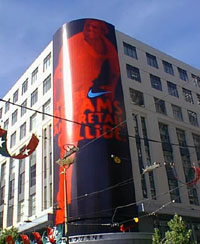
Nike is the worst offender. In the early nineties, the promoted the bejesus out of Michael Jordan to the point that many Australian kids wore Nike sporting apparel with his image on them. But if you asked any Australian kids about Jordan specifically, or basketball generally, you would draw a blank. Basketball is simply a fringe game outside of North America, and Jordan happened to be photogenic.

It wasn't long before Nike discovered that the best way to sell to the rest of the world was to go for local sporting celebrities.

The face of Nike in Australia was Shane Warne - quite possibly the greatest spin bowler that world cricket has ever seen, or at least until Muttiah Muralitharan came along. Nike didn't stop there.

They hit serious paydirt when they sponsored Ronaldo and the rest of the Brazilian national football (soccer) team in a year when Brazil were unstoppable in winning a fourth world cup and they then managed to re-create this in 2002 when Brazil did it again.

And the posters of surfers always had their sponsors figuring promptly as well. Show me a poster of a surfer without a Billabong or Rip Curl logo in the corner and I'll show you a magazine logo instead.

But the whole argument that sportspeople are role models appears to be somewhat contrived, particularly when no one takes the notion seriously that musicians gracing other kids walls might also be.

I put it to you that sporting goods manufacturers drive the debate around this. If not then why don't musicians ever get a look in?

For the record, my role model, if I had one when I was growing up, was my dad. I don't think I ever had a poster of him on the wall. And I don't think that I'm different to many others.

27 March 2007

Ben Cousins. Again. Yawn.

The media have gone bananas again.

Not that Ben Cousins doesn't bring it upon himself, though.

But let's just re-cap for those who don't know who Cousins is.

Cousins is probably the highest profile footballer in the AFL at the moment. He won the Brownlow Medal in 2005, which is the league's official Best and Fairest award, voted for by the umpires who officiate at each game.

In 2005, he also won the Leigh Matthews Trophy, which is a Most Valuable Player award voted for by the players. I will note here for my non-Australian readers that the Matthews Trophy doesn't have anywhere near the amount of kudos that the Brownlow Medal does as an individual award, but it still shows the level of esteem he is held in by the other players.

In 2006, his club, the West Coast Eagles, won the AFL Premiership for that season. This makes him officially a champion.

But off-field is where, like another great champion, Wayne Carey, he is more likely to be remembered.

During the end-of-season celebrations in 2002, Cousins was involved in a punch-up with fellow Eagle, Daniel Kerr.

In 2005, Cousins and team-mate Michael Gardiner famously refused to aid police after an incident involving a stabbing and a shooting at Perth's Metro City nightclub.

Incidentally, West Coast management told the pair that they were on their last warning after this affair.

And in early 2006, Cousins stopped his car and did a runner after noticing a booze bus up ahead, and working out that he was well over the legal blood-alcohol limit. He was fined for that, and no doubt copped some ridicule from other players over it.

Then in December 2006, he was arrested outside Crown Casino in Melbourne after getting a little rowdy and then passing out outside. Some incriminating photos were published by the media from this affair.

West Coast's management pretty much went on record at this point and basically indicated that the club would do nothing about Cousins' repeated indiscretions for no other reason than that he is a star player.

But the most recent events are surreal, even by Cousins' low standards.

Cousins' was suspended indefinitely after not showing up to training on repeated occasions.

Speculation mounted before finally it was revealed that Cousins had a drug problem.

Now this is where I get upset.

Cousins problems, bad as they are, relate to recreational drugs. The way that the media are going after him, though, you'd think that he was busted for blood-doping or something anabolic.

Now the AFL does not have a good record with regards to recreational drugs. Being sponsored every other year by either Victoria Bitter or Carlton Draught is hypocritical in the extreme. Alcohol is a recreational drug.

But the AFL wouldn't be alone in this regard.

Cousins should not let his recreational drug use interfere with his career as a professional footballer, however, his recreational drug use is his business, and his alone. And let's not forget, that this only came to light because several Eagles, including Cousins, were drug-tested the day before this was made public.

Some in the media are trying to spin it that Cousins' fall from grace is due to breaking up with his long term girlfriend, but this is also none of anyone's business.

So why are sporting bodies so fixated on recreational drug-use? Provided it doesn't interfere with one's career, one should be free to do whatever they like in the privacy of one's own home, or in a club, or at the pub?

Some have suggested that it's to protect sponsors from Big Alcohol who rather like people to keep chugging their product. If they're not because someone's smoking grass or having a few hits from a ice pipe, Big Alcohol is, quite rightly, going to get upset. After all, they sponsor the game and it's not through altruism, either.

AFL footballers are largely well known for their superhuman intake of alcohol, and this makes them all round good guys in the eyes of the media.

But here's the rub.

While Cousins' "substance abuse" problem is well known, when was the last time you heard of a footballer being 'outed' with an alcohol problem?

Since Cousins' problems were made public, several other key pieces of innuendo circulated about other players' problems in the same vein. Pun unintentional.

But we all remember Dale Lewis being sent to Coventry by the media for suggesting that footballers recreational drug use was anything other than alcohol.

The AFL, the media and the West Coast Eagles Football Club are seriously guilty of burying their heads in the sand on this issue for too long. People, and I like to think that footballers are people too, indulge in all manner of recreational drugs. Just why the hypocrisy exists is a complete enigma to me.

Edit 27/03/2007: Greg has put up a ripper post on this, and my learned advice is to check it out.

Footnote: The mighty Swans play the Eagles this weekend in Round 1 of the 2007 AFL Season. Go Swans!

08 March 2007

Carnage!

Yessireebob, there has been some carnage on the markets over the past week.

And on the whole, I have to applaud the sensible handling of this issue by the media. It was about six years ago that the infamous Tech Wreck happened, and some markets (for example, NASDAQ) around the world still haven't clawed back the ground that they lost during this time.

You may recall that the media fanned the flames caused by the fallout of the Tech Wreck by suggesting in no uncertain terms that investors were 'cutting their losses' by selling up.

Well, there has been none of this irresponsible talk in the media this time around, at least, in the Australian media, anyway. Most of the media commentators I've read are taking a pretty philosophical approach.

So what caused this?

Ostensibly, it appears to have been caused directly by a large slide on, of all places, the Shanghai Stock Exchange. This was a fall of about 9% on the back of fears that the People's Bank of China was about to introduce capital controls to limit speculation by hedge funds.

The fact that markets around the world were spooked by this is a pretty sad indictment on investor confidence generally.

For starters, the SSE has a total market capitalisation of only about CNY 7.2 trillion, which equates to AUD 1.2 trillion or USD 915 billion.

Compare this with these stock exchanges to see how piddly and little this is (all USD):

NYSE = 15.4 trillion
NASDAQ = 3.9 trillion
Tokyo = 4.6 trillion
LSE = 3.8 trillion

(Source - Wikipedia)

In fact, all the world's big stock markets are massively bigger than Shanghai.

Even the Australian Stock Exchange (ASX), which is not all that big, holds a healthy USD 1.1 trillion, which makes it larger than this tiddler.

Of course, the Shanghai Stock Exchange (SSE) is growing at a furious rate. Much faster than it's little brother the Shenzhen one, and faster still than Hong Kong, which was tipped to be THE stock exchange of China.

Here in Australia, though, the media has been relatively muted on the subject of the markets.

This could be partially due to the fact that the ASX has been one of the world's best performing bourses for three years running. Perhaps that has contributed to the general mood of the media which appears to have taken the attitude that this was a slide that was inevitable.

The ASX has been going gangbusters for some time, and was probably overdue a correction.

But should the concern over the slide in Shanghai have crossed over to the rest of the world's markets in the way that it has? This blogger thinks that the attention that Shanghai is getting is just a little idiotic.

More importantly, though, would restrictions on hedge fund movements in and out of China be a bad thing?

During the South East Asian currency crisis of the late 1990s, the then Malaysian government of Mahathir Mohamad imposed currency controls in order to stem the flow of money out of the country. Commentators everywhere decried this move against a 'free market', but in the end, things worked out well for Malaysia, which came out of the crisis largely intact, as opposed to some of the other member of the SE Asia bloc.

I remember very well at the time Mahathir accusing George Soros of ruining Malaysia with currency speculation.

Fast forward to today, and it appears that there is still paranoia in Asia over hedge fund activity.

The Chinese are being incredibly hypocritical if they are considering capital controls - the People's Bank of China (PBOC) now currently possesses roughly USD 1 trillion of foreign currency reserves. This makes it a powerful player in it's own right.

And it's not immune to its own brand of currency speculation. About this time last year, it engaged in a massive forward contract on the AUD in USD. The AUD was about to sink below USD 0.70 and it became in PBOC's interest to enter the market and short the AUD in order for their deal to pay off.

Meanwhile, the PBOC has kept the renminbi (CNY) at unfeasibly low levels against the rest of the world. It's really no wonder that all this foreign cash if flooding into China.

But as yet, China is not an economic powerhouse. Market reactions around the world to this are patently immature. Maybe in a few years time when the Chinese economy really has some clout, then this scenario would make more sense.

Standard but necessary disclaimer: This is not advice. Only a complete idiot would think that any of this constituted advice. It's not even vaguely reasonable to consider this to be advice. If you are in any doubt as to the content of this, see a good, independent financial adviser immediately. They do exist.

18 May 2006

Blah blah, da Vinci Code...

One of the great things about media bandwagons is the choice of who you sit next to when you inevitably jump aboard.

There are usually so many bitchingly brilliant angles to explore.

Writers like myself just have an absolute field day, because you can just pick and choose whatever it is that you want to write about. From whatever angle you like.

Take the Beaconsfield mine disaster in Tasmania recently.

Disaster!

Media brings in big guns into a small Australian country town and goes berzerk.

We had the media on miners, mines, unions, corporations, digging techniques, pie shops, buried miners' families, you name it it was there.

And if it wasn't stuff like that, we had a few jealous hacks going after other media identities - take the Herald-Sun's incredible character assassination attempt on Naomi Robson.

Robson happens to be pretty much teflon coated, so the Hun's attack will probably be considered over time to have been in vain.

(Still pondering the motive for this one. Who exactly did Robson manage to piss off?)

So the next big media blockbuster appears to be the release of what is possibly the year's most anticipated movie: The da Vinci Code.

One other angle that can be pursued for any media bandwagon is the good ol', "I'm not writing about this. This is beneath me. Media bandwagons suck," angle. They're always good.

How many times have I refused to comment on the Big Brother phenomenon, even though by the end of the season, the media is positively swimming in it?

But anyway, back to the da Vinci Code movie.

Regular readers of my blog are probably rolling their eyes and thinking, "Oh God. No. Not another sodding article bagging the church."

I'm gunna surprise the pair of you because I'm not going to write about that.

This goes back to the point that I raised at the start, and that there is so many topics I could write about from the insane media circus that is this movie:

1. The secret world that is Opus Dei.
2. The inevitable call to boycott this movie by various church groups.
2. The likelihood of Jesus Christ being someone's dad.
3. The religious nuts going mental as a result of someone challenging their worldview.
4. The silliness of believing anything in a book that is clearly labelled near the barcode as being "Fiction"
5. The hypocracy of the Danish film distributors (they're refusing to show it)
6. The sensitivity of the Danish film distributors for refusing to show it after the cartoons fiasco (told you there were many angles)
7. The acute embarrassment Dan Brown must find himself in, having based his book on a known forgery.
8. The work of genius of Brown - would anyone else have thought of deliberately basing a novel on a forgery? (yes, I know it's been done before - this is me playing devil's spin doctor, now)
9. Was Audrey Tautou miscast? Would Sophie Marceau have been a better choice?

That will do.

These topics have been done before, and reasonably well, too.

The Two Percent Co did it superbly here.


They even got stuck into the albinos who are protesting that it puts all albinos in a bad light.

See what I said about so many angles to choose from?

Instead, I'm going to go after all the highbrow types out there who will bag this movie despite not having seen it.

Now, for those of you who have been living under rocks, The da Vinci Code was written by Dan Brown some years ago.

It was a bit of a sleeper on the bestseller list initially, but eventually word of mouth got around and people started reading it.

And I mean, READING IT. I was on a train home from work roughly two years ago, and you could not turn around without seeing someone reading the sodding thing.

And when they finished that, they went straight out there and bought Angels and Demons (the book that Brown wrote about the book's protagonist prior to The da Vinci Code), as well as the Tom Clancy-lite stuff that Brown has also written.

I had to see what the fuss was about. So I read it.

Is it a good read?

Well, it's badly written and poorly researched. The characters are never fleshed out, and the dialogue is pretty normal - there are no Tarantino-esque moments here.

Some of the plotlines are stolen from other stories and the twists in the middle and near the end have been done better hundreds of times before.

I'm not going to begin on how implausible the whole thing is.

But is it a good read?

Yes. Quite frankly, the book is a ripsnortingly good yarn from start to finish. I could not put it down.

And even though some of it was quite predictable, it was entertaining.

The problem that the highbrow face is that literary fiction is not exciting. They can't understand why the written equivalent of a High Budget Action Movie can be considered fun. And they see this fun being radiated, which creates a type of jealousy.

So they transfer this jealousy back onto consumers of popular fiction, in the same way that classical music afficionados bag rock and/or roll.

Or that fans of subtle forms of humour such as dry wit and satire do when they shitcan truly funny forms of humour such as double entendre, slapstick and smut.

I wrote a blog post about this once...

But geez. Enough about the book.

Let's jump to the movie.

Why the distributors even entertained the notion of launching it at the Cannes film festival is beyond me.

The critics put the boots in so far that I think Ron Howard must be feeling like mashed potato.

Honestly, Apollo 13 and A Beautiful Mind were amazingly good flicks. But Howard is a movie lightweight. His career has been largely pedestrian filler that does not have the same kind of vision as your truly great directors such as Tim Burton, Terry Gilliam, Peter Jackson, the late Stanley Kubrick or Quentin Tarantino to name but a few.

But what critics like and don't like is not a reliable guide to whether a movie is any good or not.

Take for example that godawful movie Lost in Translation.

Not one critic disliked this movie.

However, I can say without exaggeration, that it was one of the two most appalling wastes of time that I have ever spent inside a movie cinema.

The other was Waking Life - if I was this pretentious, I would be shot. Why did this not happen with the film stock for this movie?

And when I say shot, an elephant gun at 5 paces ought to render the celluloid unrecoverable.

But back to the movie I'm supposed to be writing this post about.

The da Vinci Code. Grr.

I've already heard highbrow friends complain that this movie is crap. And they haven't seen it yet. The initial wave of abuse from critics and the highbrow alike is truly monumental.

This reminds me of the last time I saw this:

Armageddon.

This was a fun little High Budget Action flick built on what can only be regarded as a frightfully wrong premise. That is, a comet will crash into the earth unless it's blown up first. So why not fly a bunch of oil rig operators up to blow it to smithereens with a big nuke?

The initial wave of critical rape crashed, much like the wave in the other disaster flick of this period whose name escapes me, and in the second wave of reviews, critics backlashed against the first bunch of critics.

Suddenly, movie criticism was interesting.

I'm tipping that this will happen to this movie.

You see, the thing that is most predictable is not aspects of the plot.

It's how the critics behave.

30 March 2006

Martin Bryant is not news. Official.

This article from Crikey points out some problems with political correctness.

A few in the media have pointed at an article on Martin Bryant in the Bulletin and concluded that it should not have been written. Apparently we should pretend that it didn't happen for fear of all the usual things.

Let's just put this in perspective.

It's 2006. Ten years since the Port Arthur Massacre.

This single act resulted in what is well and truly the greatest legacy that the Howard government will leave behind, that is, a government with enough guts to pursue gun control.

Yet the media is saying that a "well researched and written article" (Crikey) is not news?

Once again, Crikey is right on the money, here. What I don't get is that political correctness is being milked for popularity's sake (take a bow, Peter Blunden and Neil Mitchell).

Funnily enough, political correctness gone berzerk is what Blunden and Mitchell specialise in pointing out.

A strange old world, this one.